Preface: I wrote this piece for a class on multimodal ethnography I took in fall 2021. The assignment was to study the materiality of an item and its cultural significance. As an avid gamer and lover of all things Animal Crossing I contemplated the ways in which the buying, selling, and trading of items on Animal Crossing New Horizons were culturally significant to Facebook communities.
Animal Crossing New Horizons just updated with 9,000 new items. Within the game, players can buy items from Nook’s Cranny (the general store on the island), build them themselves with DIY recipes, or through the ATM in the residence center. But outside of the game, there is a whole network of people who buy, sell, and trade Animal Crossing items. For example, Nookazon is a website dedicated to buying and selling items for currency within the game. At the same time, some people have started small businesses selling DIY recipes and items for out-of-game money. In addition, some communities have formed out buying, selling, and trading of items along with groups where people show off how they decorated their island with said items.

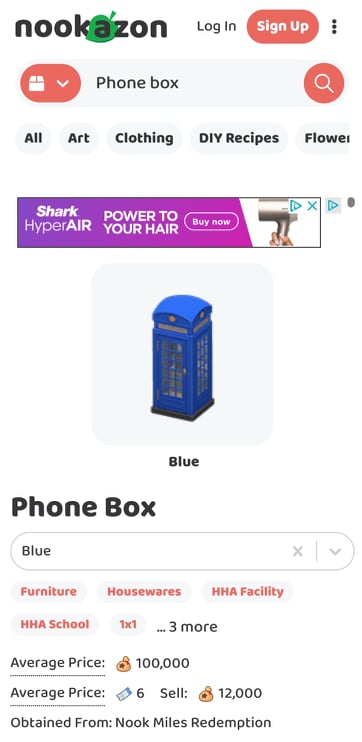
Part of the appeal of buying items from other people is due to color variations within the game—some items a person can only buy in one color because they are specific to their island. For example, through the ATM in the residence center, a player can exchange Nook Miles (a form of in-game currency) for items like a Phone Box (figure 1), which only comes in one color option that cannot be changed. If a player does not like the default color option on their island, they can exchange with other players who might have the color they want, which is where Nookazon comes in (figure 2 & 3). The exchange of digital objects is part of the appeal of the game, players want their island to look nice, and by exchanging items, relationships are formed. Physically the only objects being handled in person by the player is their Nintendo Switch, but within the game, the many objects can be manipulated.

The game’s limitations dictate where items can and cannot be placed, which places boundaries on how objects can be used. Even if there is counter space, gameplay limits might not allow for items to be put on that surface. While the entire island is, for the most part, customizable, the size of objects is measured by squares (figure 4 &5) where two objects cannot be placed in the same square or on the line between squares. These limitations significantly impact how players, and most specifically their avatar, interact with items. A player can have an item, but it could be functionally useless without the space to display it. Despite the item’s size, they can be held in the avatar’s “pockets,” yet the item cannot be placed or turned without enough room on the island. The “pockets,” while holding items of any size, also have a capacity limit that one must pay in-game to expand. Another limit is the use of tools; as one uses a tool to modify their island, the tool breaks down until the player must buy another one. Unlike other objects in the game, where once you have it in your possession, nothing will happen to it, tools must be constantly constructed or purchased because they will break.


Most items in Animal Crossing New Horizons are a digital representation of a real-life item. Objects like mugs, stoves, plants, and the like can be found in a user’s everyday life. There are also culturally specific objects related to holidays like an ox figurine (figure 6) to celebrate Chinese New Year, which might not be a specific offline object but relates to events offline. Since Animal Crossing has a global market, events and items targeted to various cultures are incorporated. For example, the Brazilian celebration of Carnival is an event within the game that includes the collection and display of multiple items to “prepare” for the event. These items are also island-specific, with buy, sell, and trade groups discussing which color and version they have and what items they want.

Certain items become symbolic of the game within digital communities, like the “Froggy Chair” (figure 7), which was not a part of the original Animal Crossing New Horizons game but was added in the latest update critical reference points. The excitement players expressed when it was revealed that the “froggy chair” was being released was immense. Before the item was in the game, players would discuss their longing for a “froggy chair” and how they missed it from previous games. As far as I am aware, very few people have recreated a “froggy chair” in the physical world, yet there is communal importance of the “froggy chair.” Through buying, selling, trading, and discussing objects in Animal Crossing, communities are formed, generally through social media but possibly in person, thus contributing to the connection of many players to each other.

Some players run islands specifically to catalog items. The process for using a catalog island is as follows: travel to the island, find the item you want, pick it up, put it down, repeat with any other items, and go back to your island to buy them through the NookShopping application. Islands used strictly for cataloging are often very utilitarian, and the codes to travel to them are kept to smaller Animal Crossing communities. The acts of picking up an item (thus having the item in one’s possession) and then putting it down tells the game the player can now have access to purchasing the item in-game. When on the ground, items are shaped like a leaf (figure 8 & 9), which does not represent an item but the concept of an item. Going to an island to catalog items is strictly interacting with the representation of the items. The play picks up and puts down the leaf to be able to buy the item later. Processes like this where the primary interaction is with the representation of an item bring up a larger question of what it means to own a digital object.


As more parts of life become digital, the way digital material is discussed becomes essential. To have a digital object is different from owning a physical object since the person does not experience the object’s physical nature. When I buy an object in Animal Crossing, I can only consider what it could be like if it were a physical object. My avatar can hold and manipulate the object, but I am still only touching my Nintendo Switch (figure 10). In a way, this is like NFT’s and cryptocurrency, where the possession of digital art or money only occurs in the digital. I cannot hold cryptocurrency in my hand and physically exchange it with another person, much like the items in Animal Crossing cannot be physically held. Likewise, when people cannot see each other in person due to distance or a global pandemic, Animal Crossing provides a place to meet up even if no item exchange happens.

Meeting people and hanging out in the digital world is nothing new; Tom Boellstroff writes about digital communities in his book Coming of Age in Second Life, but COVID forcing everyone to move their communication online sheds a different light on the issue. The interactions and material exchanges players have within Animal Crossing New Horizon are all digitally mediated and have limitations due to the nature of the game. However, there is still a material culture within the game. Simply seeing a picture of the object of one’s desire is not enough but having that object on one’s island is the ideal. Not having a specific object or a beloved object like the “froggy chair” available in-game is less than ideal for most players. Some go as far as to exchange real-world money for objects within the game which underscores the value of digital items to players.
The question becomes, what does it mean to own an object digitally, and how can these objects be discussed when existence is strictly within the digital world? Animal Crossing New Horizons demonstrates how video games and digital worlds with their own material culture create communities of people who connect over the objects. All objects in Animal Crossing are digital representations, but they are treated like physical objects through the process of exchange (be it trade or buying). Also, there is a temporariness to digital objects like the ones in Animal Crossing; if your game crashes, you can lose everything, whether you bought the items in-game or through a third party using offline money. Digital worlds and their materials are important to people, be it through games or investing in cryptocurrencies. Digital objects are still objects even if they can not be held and manipulated offline.
 Sara Schmieder